May 20, 2026
Charity Village Podcast: AI Adoption for Nonprofits
A blunt reality check on why mission-driven orgs lag on AI — and how to catch up
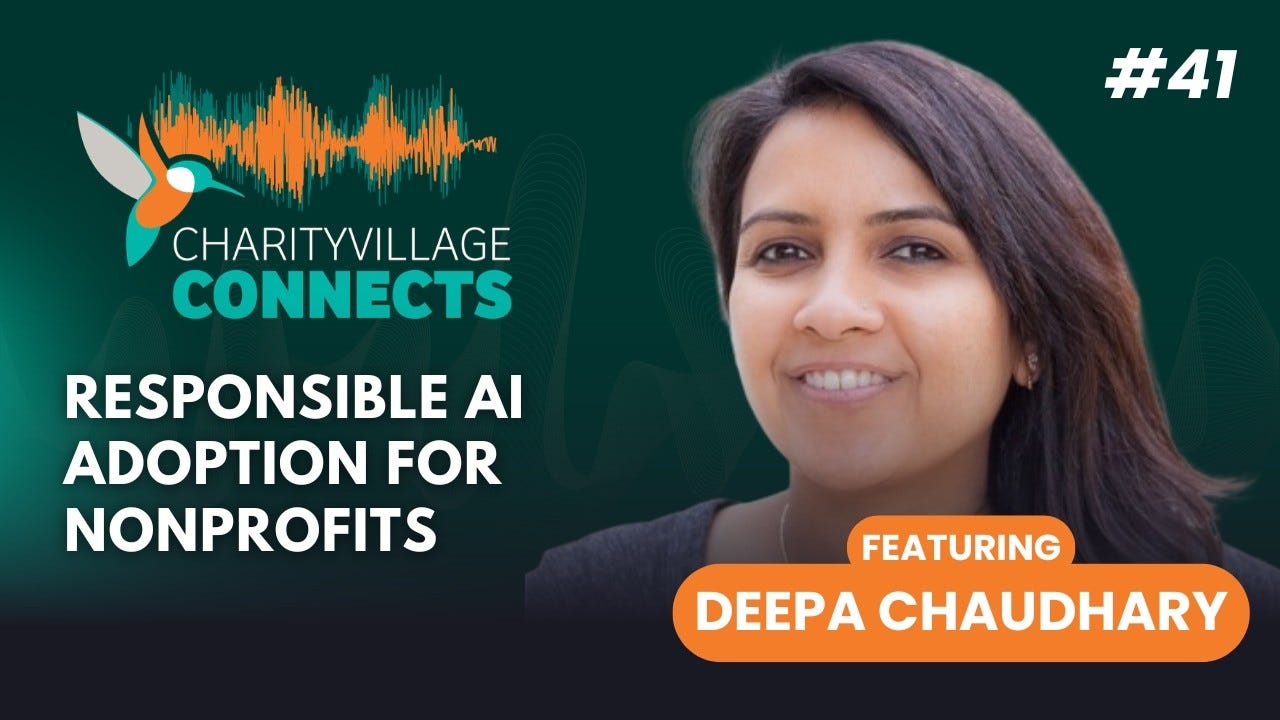
Let’s be entirely honest about the reality of the social impact space: Changemakers are notoriously expected to do absolutely everything with almost nothing.
Brilliant do-gooders on the ground are forced to act as full-time grant writers, graphic designers, data analysts, and copywriters — all while trying to actually run their programs on the front lines.
We are utterly overwhelmed by administrative strain, sitting behind desks, frantically trying to secure the next dollar while our actual missions sit on the back burner.
I recently sat down with Mary Barroll on the CharityVillage Connects podcast to talk about how AI can flip the script on this broken framework, and why so many movement leaders are getting it terribly wrong. Mary grilled me on the hard operational realities, from data privacy risks to whether AI will widen the equity gap between those who adapt and those left behind.
The underlying truth of that interview is backed up by stark, objective research. Sector studies reveal a bizarre paradox: while a staggering 92% of social impact organizers have rushed to adopt AI, only 7% are actually seeing major, mission-level impact. Most are stuck in the chatbot world, using basic LLMs to write slightly faster emails, rather than structurally changing how their campaigns operate.
If you are a builder currently drowning in “everything,” this conversation is a must-watch.
Once you start looking at AI as infrastructure rather than a hidden personal shortcut, your execution bottleneck will be removed forever.
Here are the 4 core shifts we discuss to move past basic tool-dependency and build real organizational capacity:
1. From “Doer” to “Editor & Director”
When you are orchestrating a movement, your role has fundamentally changed. You have received a promotion.
We all have got a promotion. We are not the doers anymore. We are the editors. We are the directors. Our role is to guide the AI. Our goal is to instruct the AI. So I think if we get that right in our mind, then we know that AI is somebody that’s working for us, and we need to make sure that whatever we put out in the world, we as humans verify that information before it goes out.
The AI handles the friction of the execution in seconds; you use your critical thinking to ensure the human truth is protected.
2. Instant Skill Upgrade
When you run a lean campaign, you are told you have to learn every single creative and technical discipline the hard way. Not anymore. The technical barrier to execution speed has completely collapsed.
Whatever skill you don’t have, you can instantly download that skill. You don’t need to be a graphic designer. You don’t need to be a video producer. You don’t need to be a fundraiser. You don’t need to be a grant writer. You can instantly download those skills and launch, get things done, it gives you the speed. The struggle word is not in my life anymore. I don’t struggle for anything. I don’t stress about anything because I know I have AI.
If you can have a conversation in clear, everyday English, you possess the keys to execution.
3. The Ultimate Operational Equalizer
For decades, the funding ecosystem has been rigged in favor of institutional scale. Massive, centralized legacy systems naturally captured the lion’s share of capital simply because they had the administrative machinery to churn out endless paperwork.
It’s democratizing fundraising. That’s the number one takeaway because everybody now has this same capacity. Doesn’t matter what your size is, as long as you have access to AI, you can accelerate. You could be a small frontline organization and you can compete with a nonprofit with a team of 100 people.
The data completely upends the myth that you need massive institutional funding to win with technology. Small, agile operations consistently report a higher rate of immediate operational impact when building an everyday “AI muscle.” Because our teams are forced to wear five different hats simultaneously, we adapt and deploy out of pure survival necessity.
4. Hyper-Individualized Outreach
The generic, faceless mass email blast is dead — or at least, it deserves to be. When generating tailored content takes seconds instead of months, there is zero excuse for lazy, broad messaging to your community.
We are entering an era of micro outreach. You can create micro campaigns for each individual if you know what their preferences are because it literally takes seconds to create. We’re not talking about spending months — we’re talking about seconds. You can reach out to people depending upon what their learning styles are — whether they like to learn from watching a video, reading, or music. With AI you can create content in an instant for every possible learning style.
The Bottom Line
The widening equity gap in our space won’t be between the rich and the poor. It will be between the changemakers building an everyday institutional “AI muscle” and those who aren’t.
This is the technology. It’s not going back. This is the next iteration of the internet. We need to just embrace it, use it every single day, and build that AI muscle.
Stop overthinking the tools. Treat AI like a brilliant, tireless, infinitely patient intern. Transfer your knowledge, build team-wide workflows, set your operational guardrails, and let it do the heavy lifting.
Then take the hours you claw back and use them to stand in your community, look your supporters in the eye, and build the deep, trusting human relationships that technology can never replicate.
The future of social impact is conversational. Step up to the podium and start conducting.
Originally published on Substack — read the original →.