June 2, 2026
How to Rebuild Community: The Future of Cities in the Age of AI
The Village Has an API Now
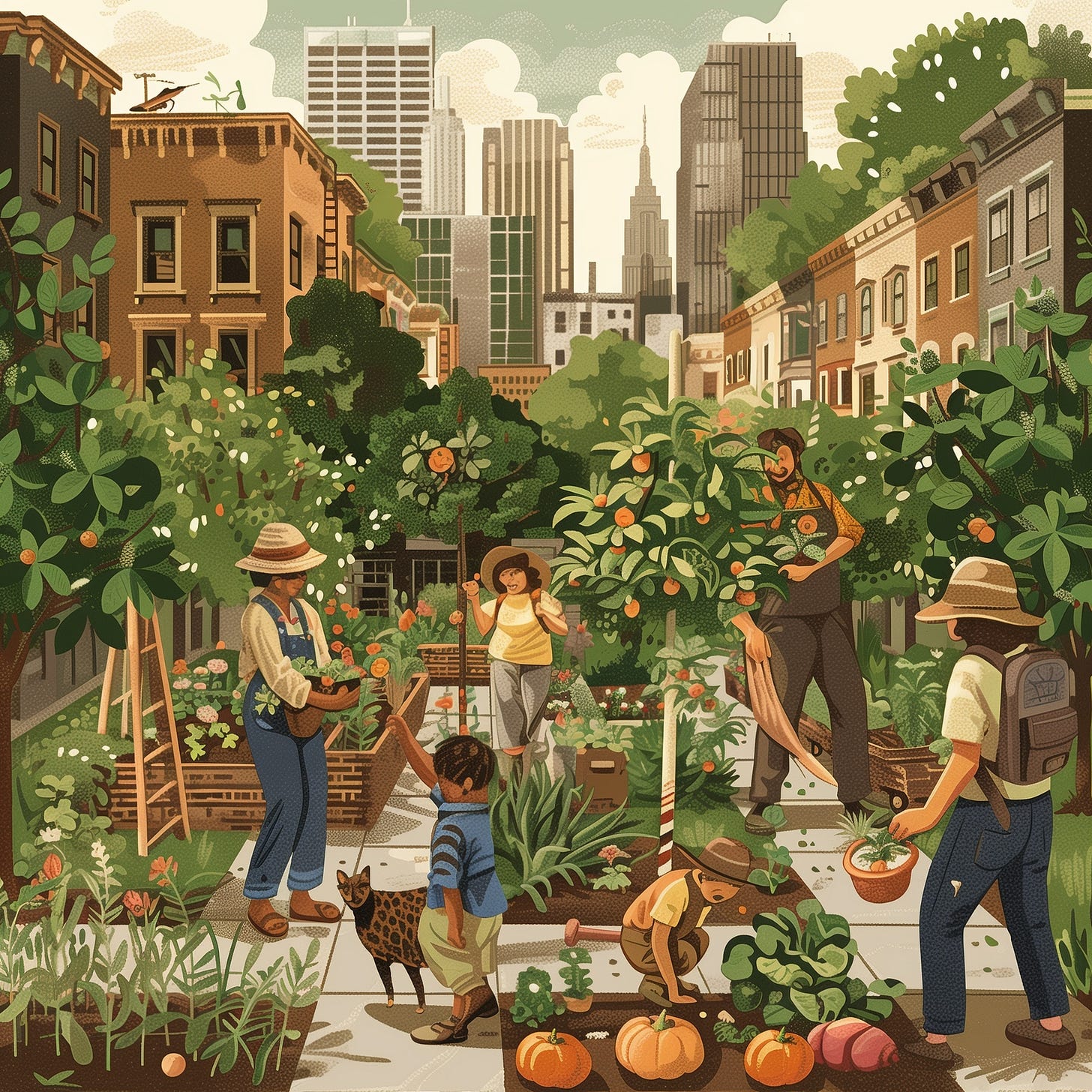
Old code, new machine — the four ancient operating systems worth resurrecting.
Let me be the devil’s advocate at the back of the room for a second. Most of what gets pitched as “ancient wisdom meets AI” is cosplay. Someone reads one paragraph about an ancient practice, bolts a token to it, and calls it innovation. It isn’t. It’s a TED talk with a folk costume on.
So I went looking for the opposite — ancient social technologies that actually worked, that solved a problem we provably still have, and that broke for one specific, identifiable reason. Then I asked the only question that matters: does the machine fix the thing that broke, or does it just paste a logo over the wreckage?
Communities broke when they outgrew the human brain’s ability to keep track of everyone. The things that broke were memory, legibility, matching, and logistics. Most candidates failed the test. Four survived. Here they are:
Enforcement, meaning, and the relationship itself stay in human hands or the whole thing curdles into the surveillance city.
1. Reputation that travels
The medieval Maghribi traders moved goods across the entire Mediterranean on nothing but reputation. Cheat one merchant in Cairo and you were finished in Palermo before your ship docked. The Hanseatic League ran on it. Hawala networks still move billions today on a phone call and a name. It is the oldest financial instrument on earth: everyone knows who you are, and word travels faster than you can.
It broke for exactly one reason — scale.
Communities got big enough that you could burn somebody and disappear into the crowd. The village’s memory had a population cap, and we blew past it.
This is the rare case where the machine fixes the actual break. Portable, person-owned reputation lets a stranger walk into a new neighbourhood and be treated like a known quantity — without a credit bureau, without a platform owning the rails, without starting from zero every time. The village’s memory, restored at city scale.
Now the devil’s-advocate knife, because this one’s a loaded gun: centralise it, make it unappealable, let one operator own the score, and you have built social credit. Full stop.
The design constraints aren’t optional decoration — they’re the entire product. You own your reputation. You carry it between communities. You can see and contest every mark against it. Get those three right and you’ve rebuilt trust at scale. Get them wrong and you’ve built the most elegant cage in history. There is no neutral version.
2. The commons, run as Ostrom actually proved
Everyone quotes the tragedy of the commons. Elinor Ostrom catalogued commons that lasted centuries — Swiss alpine pasture managed since the 1500s, Spanish huerta irrigation courts, Japanese iriai forests — and the through-line was savage in its clarity: the people who used the resource wrote the rules and policed each other. The enforcement was the community.
So here’s where the techno-solutionists drive straight off the cliff, and where my first draft of this whole thesis did too: they reach for AI to do the enforcing.
Wrong.
That’s the one job it must never have. Hand enforcement to the algorithm and you’ve evicted the humans from the only role that made the system work.
What actually broke in modern commons isn’t enforcement. It’s legibility.
A shared resource collapses when nobody can see the state of it — who’s drawing down the aquifer, what’s left in the kitty, who’s quietly freeloading on the tool library. The information that used to live in a hundred villagers’ heads has nowhere to live in a city of a million.
So make the machine the meter, never the cop.
A transparent, real-time ledger of the shared thing — visible to everyone bound by it. Then the humans do the sanctioning, the shaming, the rule-writing, exactly as they have for five hundred years. AI restores the seeing. The community keeps the judging.
3. Festival as load-bearing infrastructure
The Greek panegyris, the medieval fair, the harvest feast, the regular obligatory gathering — these weren’t decoration. They were a scheduled trust reset. Societies that endured had a calendar that forced everyone into the same space on a cadence, before the social ties had time to decay. Miss that and a neighbourhood quietly atomises into a stack of strangers sharing a postcode.
Modern districts have nothing equivalent, and it’s killing them slowly. The reason your street doesn’t throw the regular feast has nothing to do with desire. People want it. It’s blocked by the permit, the road-closure form, the insurance, the public-liability paperwork, the maddening who-brings-the-tables coordination. The willingness is already there. It’s drowning in admin.
That’s not a deep human problem. That’s logistics — the dullest, most tractable category there is.
Point the machine at the entire bureaucratic tax on gathering and dissolve it. One tap to close the street legally, sort the insurance, coordinate who’s bringing what, square the council. The cadence returns on its own the moment the friction’s gone.
No reputation engine, no ethical minefield. Just kill the paperwork that’s strangling the party. The machine never touches the feast itself — it just unlocks the door and leaves.
4. Alloparenting — the village that raises the child
The oldest welfare system on the planet isn’t the state. It’s the multi-generational household and the village that minds the child collectively — alloparenting, the anthropologists call it, and we are one of the only species that evolved to depend on it.
It carried elder care and childcare for a hundred thousand years on pure proximity.
It broke under mobility. The grandparents are in another time zone. The village dispersed for work. The proximity that powered it is simply gone, and no app conjures a grandmother out of nothing.
But — and this is the move — willingness was never the bottleneck. There is an elder two floors up who’d happily mind a kid for an afternoon. A parent who’d gladly drive someone else’s child to an appointment. The thing that’s always blocked unrelated neighbours from filling the gap isn’t reluctance.
It’s matching and trust — finding each other, and the entirely reasonable fear of handing your kid or your ageing father to a stranger.
That is a tractable problem and a narrow one. The machine does the introduction and the safety check — the vetting, the matching, the logistics of the handoff. Then it gets out of the way completely.
The relationship that follows is theirs, unmediated, unscored, unbanked. The instant you try to optimise the care itself — rank it, currency it, mandate it — you’ve turned a grandmother into a gig worker and broken the only thing worth having.
AI builds the introduction. Humans build the bond.
The line, one more time
Notice what every single one has in common: the machine handles memory, legibility, matching, and logistics — the four faculties that broke when our communities outgrew our skulls.
It never touches enforcement, meaning, or the relationship. That’s not a stylistic preference. It’s the load-bearing wall. Everything on the right side of that line rebuilds the village. Everything on the wrong side rebuilds the panopticon and calls it home.
The smart city pointed the most powerful technology in history at people and got surveillance. Point the same technology at the paperwork — at the friction, the forgetting, the not-finding-each-other — and you get something the smart city never managed in a decade of trying. You get the village back.
Older code. Better machine.
2026. Let’s GO
For questions, ideas, rebuilding societies in the age of AI, connect with the author on X or LinkedIn.
Originally published on Substack — read the original →.