September 14, 2025
Preparing Your Child for the AI Age: The Parent's Bible
What two amazing books from the past — Deschooling Society and Diamond Age — can teach us about the future of education
The AI revolution isn’t coming — it’s here. And it’s about to make everything you thought you knew about preparing your child for the future completely irrelevant.
Picture this: it’s 2030. Your child walks into a job interview, proudly presenting their college degree. The interviewer smiles politely and asks, “But what can you do that AI can’t?”
Silence.
If this scenario makes you uncomfortable — good. It should. Because while you’ve been focused on report cards and college prep, AI has been quietly reshaping the world your child will inherit, and most parents have no idea what’s coming.
But here’s the thing: we should have seen this crisis coming. We had a warning 55 years ago.
The prophet we ignored: why 1970’s warning about schools is now terrifyingly relevant
In 1970, educator Ivan Illich wrote Deschooling Society — one of the most prescient books ever written about education. While everyone else was debating teaching methods and curriculum reforms, Illich made a radical argument: schools don’t educate. They indoctrinate. They don’t create learners — they create consumers addicted to institutions.
His central insight was devastating: schools teach children that real learning only happens under professional supervision, in special buildings, following predetermined curricula. This creates adults who can’t trust their own ability to learn and grow without institutional approval.
Sound familiar? That’s your child, right now, learning to be helpless.
Illich predicted that this dependency would become catastrophic as the world changed faster than institutions could adapt. He was right — but he couldn’t have imagined how right.
The three deadly illusions schools create
Illich identified three dangerous myths that schools embed in every child’s mind:
Illusion 1: Learning equals schooling. Schools convinced society that education only happens in classrooms with certified teachers. This makes people distrust their natural ability to learn through curiosity, experience, and exploration.
Your child is being trained right now to believe they can’t learn anything important without a teacher telling them what to think.
Illusion 2: Teaching equals learning. Schools assume that having an expert deliver information to students automatically results in education. This ignores how people actually learn — through questioning, experimenting, and making connections.
Your child is learning to be a passive recipient of other people’s knowledge instead of an active creator of their own understanding.
Illusion 3: Credentials equal competence. Schools created a system where certificates matter more than actual ability. This leads to what economists call “credentialism” — the belief that degrees accurately measure someone’s potential contribution to the world.
Your child is being taught that what they can do matters less than what institutions say about them.
 What if true education happens outside the classroom? Our bet on curiosity and agency over compliance is paying off in the AI age — showing the urgent need to reimagine learning.
How these 55-year-old problems became today’s crisis
Here’s what’s terrifying: not only did we ignore Illich’s warnings, but these problems got worse. Much worse.
The dependency trap and credential arms race. In 1970, some parents still trusted their ability to teach their children important things. Today, most parents have been convinced they’re unqualified to support their child’s education. “Leave it to the school” became gospel, while what Illich called the “hidden curriculum” — teaching kids that certificates matter more than competence — spiraled completely out of control.
A bachelor’s degree became the new high school diploma. Master’s degrees proliferated for jobs that didn’t require them. Students now borrow hundreds of thousands of dollars for credentials with diminishing returns.
The industrial education complex became unstoppable. Education transformed into a massive industry with powerful vested interests. Teacher unions, textbook publishers, testing companies, and administrative bureaucracies all depend on maintaining the current system. Innovation became threatening because it might disrupt these entrenched interests.
The focus shifted from “What’s best for children?” to “What maintains the system?”
Why AI makes this 55-year crisis catastrophic
Everything Illich warned about becomes exponentially more dangerous in the age of AI. Here’s why:
When AI can learn, dependency becomes fatal. AI can learn anything instantly — while your school-trained child still waits for permission to explore their curiosity.
When AI can process information, passive learning becomes pointless. Schools trained your child to consume information delivered by experts. But AI can process all human information in seconds.
The skill isn’t acquiring knowledge — it’s asking better questions and creating new connections.
When AI can follow procedures, compliance becomes worthless. Schools rewarded your child for following instructions and giving teachers what they wanted. AI follows instructions perfectly and never gets tired or asks for raises.
Your compliant child is training to be replaced by a machine.
The skills your child actually needs (that schools systematically destroy)
While schools were creating institutional addicts, the world moved on. Here’s what your child actually needs to thrive alongside AI:
Agency: the power they’re trained to surrender
Your child needs to become their own CEO — someone who can identify problems worth solving, set meaningful goals, and take action without waiting for permission. Schools teach the exact opposite: wait for the bell, ask to use the bathroom, don’t start until the teacher says so.
Start fighting back today: Stop solving your child’s problems. When they face challenges, ask “What options do you see?” instead of providing solutions. Let them experience consequences — both good and bad.
Creative intelligence: what machines can’t touch (yet)
Your child’s creative intelligence is their greatest advantage — and schools are systematically destroying it by rewarding convergent thinking, punishing “wrong” answers, and separating subjects artificially.
AI can generate content by recombining existing patterns, but it can’t create meaning that resonates with human experience. It can’t see the connections that lead to breakthrough insights. It can’t imagine possibilities that serve human flourishing in ways we’ve never considered.
Start fighting back today: Give your child unstructured time. Boredom is creativity’s best friend. Provide raw materials, not prescribed kits — and resist the urge to direct their exploration.
Adaptability: thriving in permanent uncertainty
Your child will experience more change in their first decade of adult life than previous generations saw in their entire careers. Schools prepare them for the opposite — stable, predictable environments with clear authority structures.
Start fighting back today: Break routines intentionally. When plans change, model excitement rather than frustration. Show your child that adaptation can be adventure.
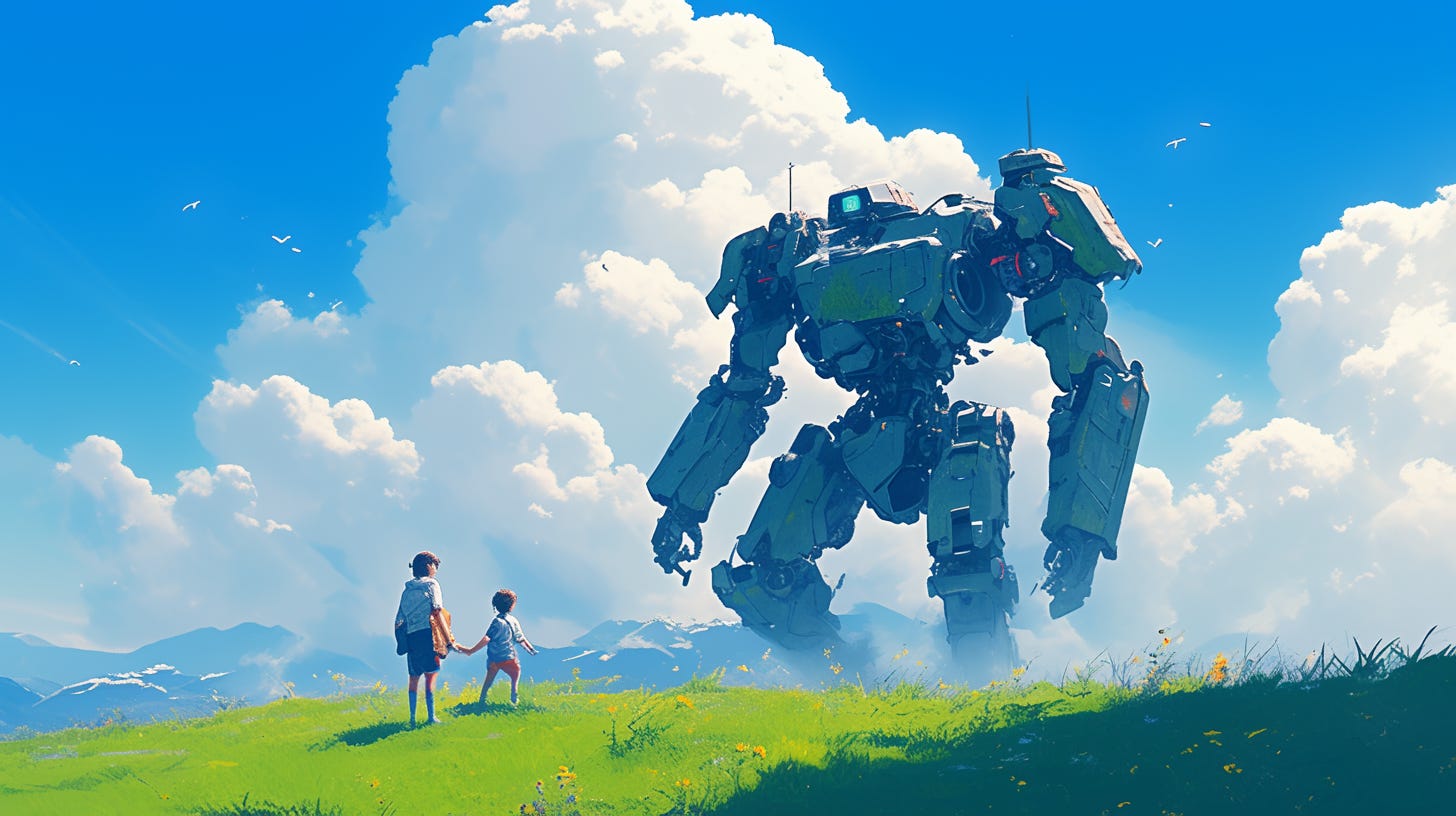
Prompt: a giant robot GPU farm walking on a grass field with two kids following it.
What the smartest parents are doing right now
The parents who understand what’s happening have stopped asking “How can I help my child succeed in school?” They’re asking “How can I prepare my child for a world where school success is meaningless?”
They’re creating “Primer” experiences. Remember Neal Stephenson’s Diamond Age — where children learned through AI companions that turned education into personalized adventures? Smart parents are creating these experiences today.
My 12-year-old is fascinated with large language models while adults are still trying to figure out basic ChatGPT prompts. Instead of dismissing this as “too advanced,” we encouraged his exploration. He taught himself how different AI models work and created projects like getting GPT-4, Claude, and Gemini to play chess against each other to see which had better strategic thinking.
While his classmates are learning PowerPoint, he’s developing skills that will be essential for the next fifty years.
They’re teaching AI partnership, not AI competition. Instead of fearing AI, these parents teach their children to use it as a thinking partner. Their kids learn to ask better questions, evaluate AI-generated answers critically, and use AI tools to amplify their uniquely human capabilities.
They’re creating real consequences. These parents have abandoned artificial rewards (grades, stickers, prizes) for authentic outcomes.
Their children work on projects that make genuine differences in real people’s lives — not just impress teachers.
The simple changes that shatter school’s conditioning
You don’t need to abandon school entirely. You can start deprogramming your child from institutional dependency with changes that make huge impacts:
Replace information questions with curiosity cultivation. Instead of “What did you learn today?” ask “What questions occurred to you today?” This single shift moves your child from passive consumption to active inquiry.
Honor their interests over artificial subjects. When your child gets curious about something — anything — support deep exploration rather than forcing artificial subject boundaries. Real learning is always interdisciplinary, always connected, always meaningful.
Create authentic decision-making opportunities. Replace multiple choice with real choice. Let your child make decisions that affect their daily experience. Support them in planning family activities, managing resources, solving problems that matter.
Ask questions that build judgment. Stop testing what they know. Start building practical wisdom:
- “What would happen if…?”
- “How might different people see this situation?”
- “What connections do you notice?”
- “If you could design this better, what would you change?”
The urgency Illich couldn’t have imagined
When Illich wrote about deschooling in 1970, change happened gradually. Institutions had time to adapt. Children had decades to recover from educational damage.
Not anymore.
AI development is accelerating exponentially. The gap between what schools teach and what the world needs grows wider every month. Your child can’t afford to spend years unlearning institutional dependency.
Every day they spend in systems designed to create compliant consumers is a day they fall further behind the future that’s actually coming.
Your move starts now
Illich’s 55-year-old critique wasn’t academic theory — it was prophecy. Every problem he identified has intensified. Every dependency he warned about has deepened. Every institution he criticized has become more entrenched.
AI didn’t create this crisis. It revealed it.
The question isn’t whether your child’s education needs to change. The question is whether you’ll act while there’s still time.
If you have questions, reach out on X or LinkedIn. For those new to my work — I write at the intersection of tech and social impact, and I’m the founder of GrantOrb.com, an AI startup democratizing access to grant funding.
Originally published on Substack — read the original →.